

From Margins to Markets: Empowering Tribal Women through Rajeevika in Banswara
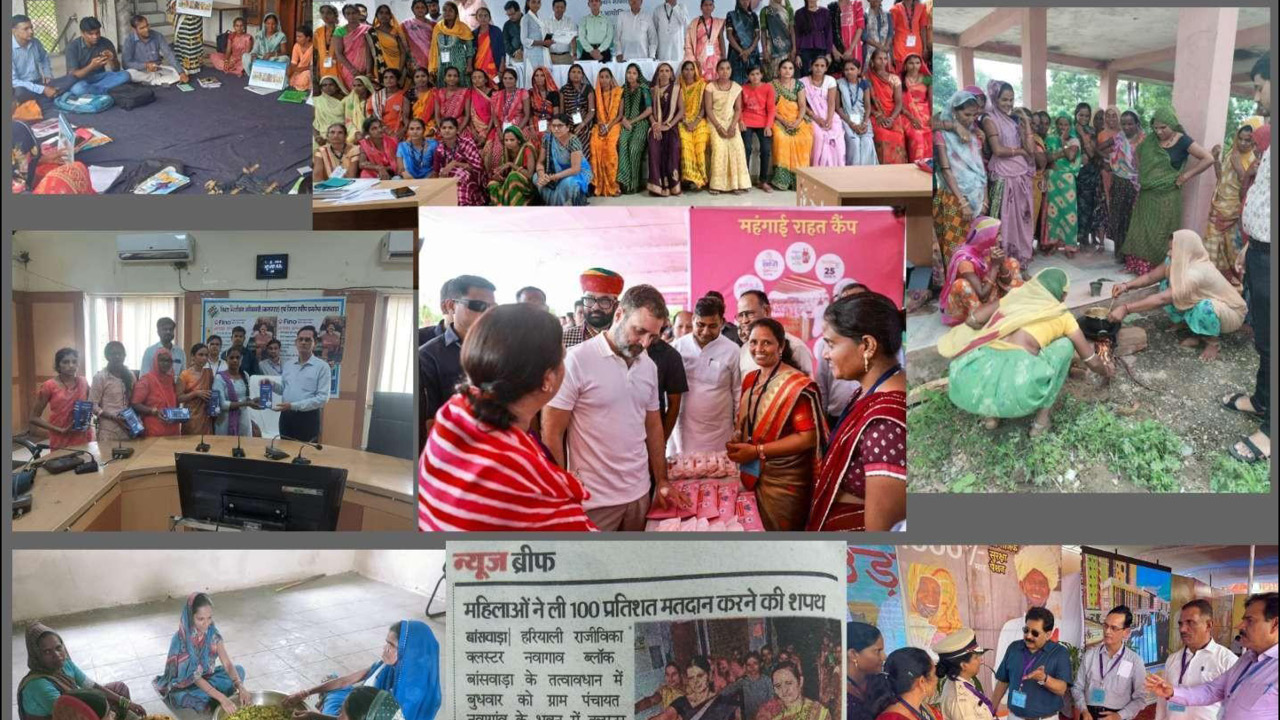
From Margins to Markets: Empowering Tribal Women through Rajeevika in Banswara
Problem
- Lack of confidence among tribal women, resulting in almost no women entrepreneurs in the region
- Women have ideas but lack skills, training, and handholding, keeping their business aspirations only in their minds
- No platforms for showcasing talent, as new entrepreneurs cannot afford branding, marketing, or exhibitions
- Limited access to finance, with women unable to secure loans from formal institutions
- Family and societal resistance, where families hesitate to allow women to step out and work
Solution
- SHG formation and weekly savings, enabling women to join groups, build confidence, and start financial discipline
- Handholding support through RGAVP & NRETP, allowing women to experiment and test entrepreneurial ideas
- Exposure through SARAS melas & exhibitions in Jaipur, Delhi, and other districts to connect women with customers and markets
- Providing loans under DAY-NRLM & PMFME, ensuring accessible, low-interest credit for enterprise development
- Marketing linkages & cultural product innovation, such as converting tribal hunting bows into professional archery sets
Outcomes
- Women gained confidence and economic independence through SHGs and financial inclusion
- A successful women-led enterprise emerged, with Payal Tirgar’s bamboo archery business scaling to ₹10–12 lakh annual turnover
- Wider market exposure, as RGAVP-supported women sell products at state-level SARAS events and expand to new states
- Access to affordable loans, helping women run and expand their businesses sustainably
- Shift in social norms, with families and communities gradually accepting women working, earning, and leading enterprises
Project Details
Category: Women Empowerment
Project Title: Women Empowerment through Rajeevika
Department or District: Rajasthan Grameen Aajeevika Vikas Parishad (RGAVP), District Project Management Unit, Banswara
State: Rajasthan
Start Date of the Project: 2nd October 2016.
Website: https://rgavp.rajasthan.gov.in/
Tribe(s) that the Project Covers: The programme primarily focuses on tribal women, especially in Banswara district, which has over 75% tribal population including Bhil and Meena communities.
Keywords: Women Empowerment, SHGs, Tribal Women, RGAVP, Bamboo Handicrafts, Archery, Tribal Livelihoods, Tribal Entrepreneurship, DAY-NRLM, PMFME, Tribal E-commerce, SARAS Mela, Herbal Gulal, Non-Farm Products
Banswara, located in southern Rajasthan, is among the 250 most underdeveloped districts in India. Characterised by its high tribal population and limited livelihood opportunities, women in this region traditionally had minimal economic or public engagement. Recognising this entrenched inequality, RGAVP initiated a transformational programme under the National Rural Livelihoods Mission (NRLM) to empower women socially and economically through the creation and nurturing of Self-Help Groups (SHGs) and related federations.
The Project
Rajeevika seeks to mobilise women into SHGs, support them through a phased development plan, provide financial linkages, and enable enterprise development through skilling and market integration. In Banswara, the programme operates across 11 blocks, 418 gram panchayats and 1,444 villages, with over 21 lakh women engaged in nearly 18,000 SHGs and supported by 44 cluster-level federations (CLFs).
Problems that it Intends to Solve
Before Rajeevika, the region witnessed low female literacy, negligible access to formal finance, and absence of female entrepreneurs. Patriarchal norms and early marriage further limited women’s participation. Women had ideas but lacked the skills, confidence, and financial backing to turn them into viable ventures.
What was the Need
A structural intervention was urgently needed to reduce gender disparities, foster financial independence, and bring tribal women into the economic mainstream. The project aimed to convert informal groupings into structured institutions capable of managing credit, savings, and enterprises.
What Hindered its Introduction
Initial resistance came from within families and the broader community, where women stepping into public and entrepreneurial roles was socially discouraged. Low education and mobility added to the hesitance. Additionally, the lack of previous models of success in the region made it hard for women to visualise long-term gains.
Process Followed for Implementation
The first step was community mobilisation, where women were organised into SHGs of 10–15 members. A phased strategy involving savings, internal lending, and credit linkages was introduced. Training followed in bookkeeping, governance, and financial literacy. Under the NRETP and DAY-NRLM schemes, enterprise support was provided through PMFME and Van Dhan Yojana funds. Market exposure was ensured via participation in SARAS Melas and exhibitions across India.
- Government Involvement
- The Rajasthan government led the initiative, funding and overseeing implementation through RGAVP. The programme is backed by the Rural Development Department and aligned with national schemes like DAY-NRLM, PMFME, and UDAN. Over ₹6.4 crore in loans were disbursed during a single chief ministerial visit, underscoring the political commitment.
- Involvement of Community and NGOs
- Local women played central roles as SHG leaders, entrepreneurs, and trainers. NGOs and community resource persons (CRPs) facilitated awareness, skill development, and initial handholding. Families were gradually included through trust-building exercises and success showcases.
Solutions Implemented
SHG formation was followed by microcredit planning and CIF funding. Products such as bamboo crafts, sanitary pads, herbal gulal, leather goods, and processed food items were developed. Notably, entrepreneur Payal Tirgar, from Ghatol block, began crafting and exporting bamboo bows and arrows with support from her SHG. Her venture, supported by Rajeevika, scaled from local sales to national exhibitions and e-commerce exposure.
Details of the Coverage
By 2023, RGAVP had reached over 7.5 lakh households, formed 2.54 lakh SHGs, established 204 Producer Groups and 80 Van Dhan Kendras, and disbursed hundreds of crores in loans. It is currently operational in all 33 districts of Rajasthan.
Innovation and Unique Features
The project’s innovation lies in blending traditional tribal skills with modern business practices. The bamboo archery sets made by SHG members not only preserve cultural heritage but also meet professional sports standards. This reimagination of tribal knowledge for commercial gain was revolutionary and won praise from institutions like Ranthambore Tiger Reserve, which placed bulk orders for bamboo bottles.
- New Approaches: Tech integration, capacity building, culturally sensitive methods
- Technology was adopted through digital accounting and e-commerce outreach. Capacity building was delivered in stages, with a focus on governance, brand identity, and product quality. Rajeevika also implemented sanitary pad units under the UDAN scheme, run by SHG federations, ensuring health and income for women simultaneously.
- Tribal women shaped every stage of the intervention—from product ideation to execution. Success stories like that of Payal Tirgar, Anita Devi (marigold farming), and Dharmistha Pandya (from SHG to CLF leader) reflect a culture of community-led transformation.
- Initially reluctant women were motivated by peer examples, access to exhibitions, and tailored training. Business models evolved from local sales to institutional orders, online platforms, and multi-product offerings. Support structures adapted to individual needs, including flexible repayment and mentorship.
Challenges Faced
- Internally, women lacked awareness, decision-making power, and mobility. Externally, community pushback, lack of markets, and minimal institutional support hindered growth. There was also limited exposure to entrepreneurial models within tribal communities.
- Some SHGs struggled with bookkeeping, while others lacked access to quality raw material. Marketing, brand identity, and scaling up also posed hurdles. RGAVP addressed these through district training centres, partnerships, and subsidies for tools and materials.
- Efforts included door-to-door outreach, family counselling, CRP-led mentoring, and linking to existing government subsidies. Regular exposure visits and media coverage further helped win community trust.
Outcomes
- Quantitatively, over ₹75 crore in loans have been disbursed to women SHGs. The herbal gulal initiative alone recorded ₹20 lakh in sales. Payal Tirgar’s enterprise now transacts ₹10–12 lakh annually. Qualitatively, there is a visible shift in gender roles, with women now seen as leaders, earners, and decision-makers in their homes and communities.
- RGAVP uses a decentralised structure of SHGs, VOs, and CLFs for internal monitoring, supported by the District Project Management Units. Impact assessments and government audits track loan utilisation, business progress, and group health.
- Over 21 lakh women across Rajasthan are part of Rajeevika, with specific success stories emerging from tribal Banswara district. Direct beneficiaries include SHG entrepreneurs, while indirect beneficiaries are families and local artisans.
Replicability / Scalability / Sustainability
Given its modular, scalable design and alignment with national missions, the Rajeevika model is replicable across tribal belts in India. Its success already resonates in other states adopting similar NRLM-aligned models. Sustainability is embedded through savings-based SHG operations and growing market demand for indigenous products.
Rajeevika operates under the NRLM and NRETP frameworks and receives state and central funding. With schemes like UDAN and PMFME aligned, long-term viability is ensured. Future goals include ₹10 lakh in expansion investment and wider e-commerce penetration.