

Leveraging Digital Tools for Tribal Education Reform: The Edu-Tribe Assessment Model in Rajasthan
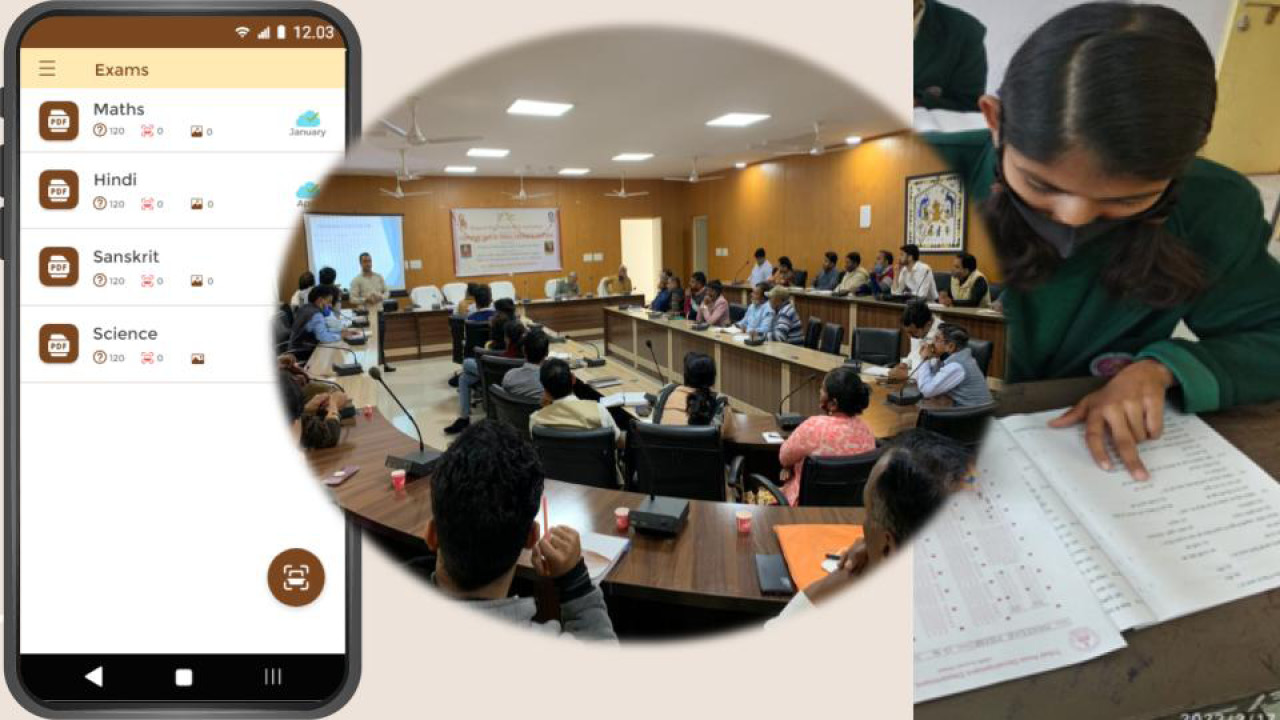
Leveraging Digital Tools for Tribal Education Reform: The Edu-Tribe Assessment Model in Rajasthan
Problem
- Inadequate Regular Assessments: Current examination system didn’t promote regular, thorough assessments
- Delayed Results: Evaluation of formal examinations consumed a significant amount of teachers’ time
- Lack of Conceptual Clarity: Students faced challenges in understanding subject content due to infrequent evaluations
Solution
- Edu-Tribe Mobile Application: Developed for instant assessment results and streamlined training for users
- Monthly Course Distribution: Regularised assessment of additional tests led by the Tribal Area Development Department, Udaipur
- Innovative Test Design: Introduction of test booklets with 3 test papers and perforated OMR Sheets for efficient result computation
- Data Analysis for Improved Learning: Instant results provided insights into students’ weak areas, facilitating targeted revision
Outcomes
- Immediate Feedback: Edu-Tribe app enabled teachers to provide students with instantaneous test results
- Improved Conceptual Clarity: Regular assessments and feedback mechanisms helped students to better understand subject content
- Efficient Assessment System: The use of OMR sheets streamlined the examination process, making it time-efficient
- Replicable Model: Due to its success, there are proposals to replicate the system for classes 6th to 8th
Project Details
Category: Education
Project Title: Quality Education Programme for Tribal Students Regular Assessment through Edu-Tribe Mobile Application
Department or District: Tribal Area Development Department, Udaipur
State: Rajasthan
Start Date of the Project: 1st July 2021
Website: https://tad.rajasthan.gov.in/
Tribe(s) that the Project Covers: The project benefits tribal students from Udaipur district in Rajasthan. This area predominantly consists of Scheduled Tribes such as Bhil, Meena, and Garasia, many of whom have historically faced educational disadvantages.
Keywords: Tribal Education, Rajasthan, Government Schools, Technology in Education
The Tribal Area Development Department of Rajasthan launched an innovative education reform project titled “Quality Education Programme for Tribal Students: Regular Assessment through Edu-Tribe Mobile Application.” With oversight of 45 residential schools and 471 hostels, the department serves 22,900 tribal students. The initiative was designed to enhance academic outcomes through regular, technology-enabled assessments. The Edu-Tribe mobile application, a central feature of the program, facilitates real-time evaluation through OMR-based testing. This enables teachers to quickly identify learning gaps and provide targeted remedial support to students.
What was the Need
The existing assessment framework in tribal residential schools lacked frequency and efficiency. Evaluations were typically restricted to half-yearly and annual exams conducted by the Education Department, delaying feedback and hindering timely pedagogical intervention. Students suffered from poor conceptual clarity due to the absence of regular assessments.
What Hindered its Introduction
Several obstacles initially hindered the introduction of this new model. There was no provision for monthly assessments within the departmental structure. Technological limitations in mapping student UIDs and teachers’ SSO IDs, combined with low IT literacy among educators and administrators, further complicated implementation. Additionally, the absence of a standardized, digital assessment platform posed significant logistical and technical barriers.
Process Followed for Implementation
- Government
- The government played a pivotal role, with the Tribal Area Development Department overseeing the design and rollout of the assessment model. It coordinated the development of the Edu-Tribe mobile application, printing and distribution of assessment materials, scheduling of tests, and data-driven performance analysis.
- Involvement of Community
- Community involvement, particularly from principals, teachers, and hostel wardens, was integral to execution. Teachers were tasked with scanning OMR sheets, analyzing assessment results, and providing remedial instruction based on identified weaknesses. Principals monitored implementation progress and ensured adherence to schedules. Through this collective effort, the initiative was smoothly introduced across the region.
Solutions Implemented
A suite of solutions was introduced to support systematic, real-time assessment. The Edu-Tribe mobile application enabled OMR-based scanning and cloud storage for instant feedback. Curriculum-aligned monthly course distribution allowed for three structured tests annually. Custom-designed test booklets, featuring perforated OMR sheets, ensured efficient data capture. Standardized timetables facilitated synchronized assessments across schools. Each student was assigned a unique ID, while teachers were mapped using their SSO credentials. Centralized data analysis helped identify weak areas at both the school and state levels, enabling focused remedial teaching and improved learning outcomes.
Details of the Coverage
The project covered 22,900 students in Classes 9 to 12, across all tribal residential schools and hostels in Udaipur. The assessments encompassed core subjects including Hindi, English, Mathematics, Science, Social Science, Sanskrit, and electives in Classes 11 and 12. A total of 1.62 lakh test booklets containing 4.86 lakh OMR sheets were printed and distributed, with three assessments conducted per academic year.
Innovation and Unique Features
- New Approaches: Tech integration, capacity building, culturally sensitive methods
- The project brought in several new approaches. It facilitated instant feedback through app-based OMR scanning and introduced standardized, objective-type testing formats. This not only enhanced transparency and consistency but also prepared students for competitive exams through early familiarity with OMR-based assessments.
- Co-creation: How tribal knowledge or leadership shaped the solution
- Co-creation was a key component, with teachers actively contributing to question development and school-level data shaping remedial strategies.
- Any adaptations: How the project evolved during implementation
- The initiative was adapted to suit the context of low IT familiarity; the training methodology was modified to accommodate digitally inexperienced teachers, and the app interface was simplified to be user-friendly in resource-constrained environments.
Challenges Faced Before Implementation
- Internal Challenges
- Several internal challenges preceded implementation. Curriculum mapping required meticulous planning to align assessments with the syllabus. Establishing the data infrastructure to store and process assessment information posed logistical hurdles. Limited manpower and departmental technical expertise hampered app development and operational coordination. Additionally, many educators lacked prior experience with mobile tools, delaying the initial rollout.
- External Challenges
- Externally, the mapping of 22,900 student UIDs and synchronization of teacher and warden profiles with SSO systems proved cumbersome and error-prone. Reluctance to adopt technology among teachers in remote areas and poor internet connectivity added further complications.
- Mitigation Efforts
- To address these issues, the department organized multi-phase digital training sessions for teachers and administrators. A centralized support cell was established to assist with UID and SSO integration. Special attention was given to making the app accessible to users with varying levels of digital literacy. The interface was designed to be intuitive, and troubleshooting support was made readily available throughout the rollout phase.
Challenges Faced During Implementation
- Internal Challenges
- New difficulties emerged once the project was underway. There were gaps in digital literacy, which initially made educators hesitant or unable to effectively use the app. Ensuring uniform test administration and timely result submission across institutions created coordination challenges. Some educators resisted transitioning to a digital system.
- External Challenges
- Externally, persistent internet issues in remote tribal areas disrupted timely uploading of OMR scans. Device shortages in some schools impeded app functionality, and the distribution of printed materials to remote locations within tight schedules created logistical strain.
- Mitigation Efforts
- The department responded by establishing a dedicated support unit to provide on-demand technical assistance. Manual upload options and staggered timelines were introduced to accommodate connectivity issues. Additional training modules and refresher sessions were conducted to support full compliance. Backup mobile devices and contingency kits were deployed through district offices to bridge hardware gaps and ensure uninterrupted execution.
Outcomes
- Quantitative
- Quantitatively, the project led to marked improvements in academic performance across all grade levels. For instance, Class 9 students showing Grade A scores increased from 5% to 12% across three tests. Class 10 saw a rise from 6% to 13%, while Class 11 improved from 6% to 16%. In Class 12, Grade A students rose from 7% to 10%, and Grade B students increased to 26%. First division results also improved in board examinations.
- A total of 22,900 tribal students benefited directly from the intervention, while teachers and education officers leveraged data to enhance instructional methods.
- Qualitative
- Qualitatively, the initiative promoted greater conceptual understanding and allowed teachers to tailor instruction to student needs.
- Monitoring and evaluation were enabled through cloud-based storage of results and regular performance analysis at the state level.
Replicability / Scalability / Sustainability
- The project is well-aligned with the National Education Policy 2020, which emphasizes formative assessments and digital innovation in pedagogy.
- With a planned budget of ₹24 lakhs for expansion, the initiative is financially sustainable and ready for scale.
- Replication efforts are already underway, with plans to extend the model to students in Classes 6 to 8. Moreover, the framework empowers teachers to independently develop and evaluate student assessments, further embedding the practice into institutional culture.